+91 9460504008 smartsortho@gmail.com

Bone Fractures

Bones are the hard structures that give shape to the body, protect organs, and promote movement. They are made of living tissue that can repair and grow.

A fracture happens when a bone cracks or breaks due to an accident, collapse, or pressure. It can cause pain, swelling, and restricted movement. With the right treatment and care, most fractures heal and allow the bone to become strong again.

  • 13+

    Years Experienced

  • 10K+

    Joint Replacement

  • 7K+

    Hip Arthroscopy

Overview

What is a Bone Fracture?

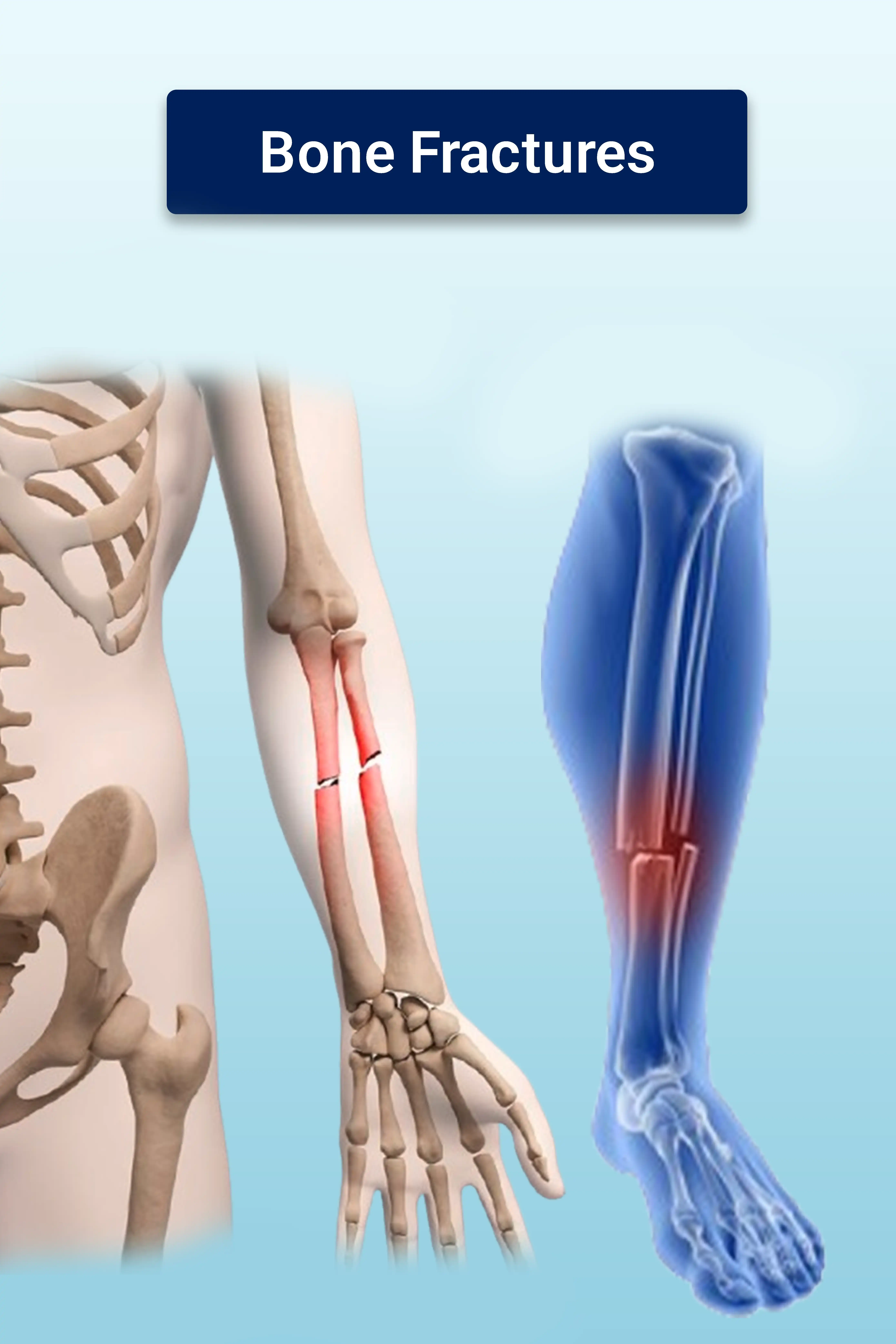
A Bone Fracture is a situation when a bone cracks or breaks due to any reason, which includes accidents, falls, sports injuries, or weak bones. It not only causes pain and swelling, but also immobility. Its treatment depends on the severity of the fracture. These remedies include rest, plaster, splints, or surgery.

With proper care and treatment, most fractures heal with time.

Bone Fracture Causes

There are many reasons behind bone fractures. Some of the common causes are as follows:

  • Car accidents: In case of accidents, fracture is a very common thing. It leaves a strong impact and breaks bones.
  • Falls: Slipping or falling from a height often leads to fractures of bones. It can be any of your body parts, such as a leg, an arm, or the back.
  • Sports injuries: Any kind of sudden twists, collisions, or heavy pressure on bones can lead to fractures of bones in the body.
  • Stress fractures: Small cracks caused by repeating the same movement very intensely also lead to fractures. These activities include running, jumping, or workout movements.
  • Weak bones: Some conditions, like osteoporosis or vitamin D deficiency, make bones weak. And, it results in fractures of bones.
  • Age factor: Bones in the human body depend on the age of a person. For instance, children (softer bones) and older adults (weaker bones) are at higher risk.

Bone Fracture Symptoms

Some of the considerable symptoms of a bone fracture are as follows:

  • Pain: Any kind of severe pain in the injured area, which becomes worse when you try to move.
  • Swelling and Bruising: When a bone breaks, the injured area often swells and shows bruises due to damaged blood vessels.
  • Immobility: Someone suffering from a fracture also faces difficulty in the movement of the affected part.
  • Visible Deformity: The bone or joint may look out of place or bent in case of fracture.
  • Tenderness to Touch: In case of fracture, even a gentle touch can cause sharp pain.
  • Cracking Sound: Sometimes, you also feel a snapping or popping sound at the time of injury.

Here are the symptoms for some specific types of fractures:

  • Hand: A broken bone in the hand causes sharp pain and swelling, which makes it hard to grip things. Broken bone hand treatment usually starts with rest and immobilization.
  • Wrist: In the wrist, fractures often lead to pain, swelling, and stiffness (wrist fracture treatment may include a cast or sometimes surgery).
  • Ankle: In the ankle, pain and swelling make walking very difficult. Ankle fracture treatment depends on its severity.
  • Leg: A bone fracture in the leg can make it hard to stand and walk. Sometimes people can not even walk properly. Proper bone fracture treatment is needed to heal correctly.

Bone Fracture Diagnosis

To check if the bone is fractured or not, the doctor first diagnoses the fractured area. Here are some methods to diagnose a bone fracture:

1 Physical Examination

A healthcare provider will check the injured area and look for signs such as swelling, deformity, tenderness, or limited movement. They will also consider the patient’s overall condition. Along with the need and type of treatment, especially at the time of emergencies.

2 X-ray

An X-ray is the most common test to check for fractures. It uses a small amount of radiation to take pictures of your bones. Doctors can easily see if a bone is broken and also the severity of damage. It is usually the first step in diagnosing a fracture.

3 MRI (Magnetic Resonance Imaging)

An MRI gives very detailed images of both bones and soft tissues. It helps doctors to diagnose injuries of ligaments, tendons, and cartilage around the bone. This test is useful when an X-ray does not show the full problem. It can reveal hidden injuries that may be causing pain.

4 CT Scan (Computed Tomography)

A CT scan creates detailed 3D images of your bones and nearby tissues. It provides clearer pictures than an X-ray. Doctors often use it at the time of planning surgery and for complex fractures. It helps them understand the severity of the broken joint.

5 Bone Scan

A bone scan is used when a fracture is too small to be seen on an X-ray. It involves a special dye injected into your body that highlights problematic areas. This test takes much time to give an accurate result about the bone fracture. It is mainly beneficial for detecting stress fractures.

Note: In some cases, doctors may also use ultrasound (especially for children) as it avoids radiation exposure and detects certain types of fractures.

Bone Fracture Treatment Options

The treatment for a bone fracture depends on the type of fracture, its cause, and severity. Doctors choose the best method after checking your condition. Here are some available treatment options:

1 Immobilization

If the fracture is mild and the bone has not moved out of place, doctors often use a splint or a cast. A splint is usually worn for three to five weeks. While a cast is kept for six to eight weeks. During this period, doctors take follow-up X-rays to see if the bone is healing properly.

2 Closed Reduction

If the bone has shifted from its place, doctors can perform a closed reduction. In this procedure, the doctor gently pushes and pulls the bone from outside the body to set it back in the right position.

To make this painless, you may be given medicine such as a local anesthetic, sedatives, or general anesthesia. After this, the bone is covered with a splint or cast.

3 Bone Fracture Surgery

Some fractures are severe and require surgery. In such cases, doctors may use internal or external fixation methods. Here are their names with an explanation:

  • Internal Fixation: The bones are put back in place and held with metal parts such as rods, plates, and screws. These help the bone stay stable while it heals. Some people keep these parts inside their bodies permanently on the doctor’s advice. While others may need surgery to remove them.
  • External Fixation: In this method, screws are placed in the bone and attached to a frame outside the body. This is usually a temporary method to keep the bone stable until further treatment.

4 Arthroplasty (Joint Replacement)

If a joint, such as the knee, elbow, or shoulder, is fractured, doctors replace it with an artificial joint. This artificial joint is made of metal, ceramic, or strong plastic and works like a natural joint.

5 Bone Grafting

If the bone is badly damaged or not healed properly, bone grafting can be done. In this process, extra bone tissue is added to help the bone grow and join again. The new bone can come from your own body, from a donor, or from an artificial piece. Usually, doctors also use internal fixation to hold the bones together after a graft.

After surgery or treatment, the bone is kept still using a splint, cast, brace, or sling. Once the bone heals, you can slowly start using it again, but with proper care.

Bone Fracture Prevention Tips

Here is a list of some popular ways to prevent body fractures:

1 Maintain a Healthy Diet

  • Eat foods rich in calcium (like milk, cheese, yogurt) and leafy green vegetables.
  • Consider Vitamin D sources such as sunlight, eggs, and fortified foods.
  • Ensure enough protein for strong bones.

2 Exercise Regularly

  • Do weight-bearing exercises like walking, jogging, or dancing.
  • Include strength training to keep muscles and bones strong.
  • Practice balance and flexibility exercises like yoga to prevent falls.

3 Avoid Risky Habits

  • Do not smoke. It weakens bones.
  • Limit alcohol intake as well.
  • Use helmets on the road to avoid accidents.
  • Use a seatbelt in a car as well and follow all the traffic rules.

4 Prevent Falls at Home

  • Keep floors clear and dry. Do not keep objects here and there.
  • Use non-slip mats in bathrooms and kitchens.
  • Always use handrails on stairs.

5 Use Protective Gear

  • Wear helmets while cycling or skating.
  • Use knee and elbow pads during sports.
  • Wear appropriate footwear for support.

6 Regular Health Checkups

  • Check bone density if you are at risk of osteoporosis.
  • Take medications if prescribed to strengthen bones.

How can We Help with a Bone Fracture?

A Bone Fracture not only restricts movement but also leads to severe pain. It requires immediate care and treatment by an orthopaedic specialist. Here, we believe in offering medication and consultation with personalised care to our patients.

We examine your fracture, provide an accurate diagnosis, realign and immobilize the bone. Also, we prescribe necessary medication and guide through full recovery with personalized care.
Frequently asked questions

Fractures in the hand happen when one or more bones in the hand break. It can cause pain, swelling, and trouble moving your fingers. Immediate medical attention helps prevent complications. Proper treatment ensures the quick and effective healing of the hand.

Fractures in the leg happen when the thigh, shin, or foot bones break. You may feel severe pain and swelling at this time. Sometimes it also leads to immobility of the injured person.

For a broken hand, the doctor may put a cast or splint to keep the bone in place. Sometimes surgery is needed if the bones are badly broken. Any kind of casualty at the time of injury can lead to the severity of the fracture.

Wrist fracture treatment usually includes immobilizing the wrist with a cast or splint. A doctor often prescribes pain medicine and rest to help with healing. In some cases, surgery can be an option.

Ankle fracture treatment may include casts, braces, or surgery, depending on the severity of the fracture. If you keep your ankle elevated and avoid putting weight on it, then it heals faster.

Book An Appointment

Contact us to any help

  • Newsletter

    Lorem ipsum dolor sit amet consectetur adipisicing elit. Cum, a.